
Industrial 3D printing in South Africa - One-day Seminar
Cape Town
Making the Leap: How Additive Manufacturing Can Work for You
📅 Date and Time: Thursday, 18 June 2026, 8:30 – 16:15
📍 Location: Cape Town Creative Academy, Waterfront, Cape Town, South Africa
🎟️ Limited tickets available

Join us for an exclusive one-day seminar designed to help businesses and individuals unlock the full potential of industrial 3D printing. Whether you’re new to Additive Manufacturing (AM) or already exploring its possibilities, this event will bridge the gap between interest and action
—helping you transition from exploration to full-scale adoption.
Why Attend?
✔ Understand Additive Manufacturing’s Impact – Learn how Additive Manufacturing is transforming industries, from aerospace and automotive to tooling and medical applications.
✔ See Real-World Success Stories – Gain insights from case studies showcasing 3D-printed parts in action.
✔ Overcome Adoption Barriers – Address key concerns like cost, learning curves, and return on investment (ROI).
✔ Exclusive Networking – Connect with industry leaders, manufacturers, and Additive Manufacturing experts to explore collaboration opportunities.
What to Expect
📌 A mix of technical deep dives, real-world case studies and interactive Q&A sessions
📌 Real businesses that implemented AM into their workflow will chat about their experiences
📌 Dedicated segment on how Additive Manufacturing fits into South Africa’s industrial landscape and how businesses can leverage it for competitive advantage.
Who Should Attend?
• Manufacturers looking to integrate industrial 3D printing into their workflow.
• Engineering teams exploring new production techniques.
• Product designers who would like to understand the capabilities of Additive Manufacturing.
• Companies wanting to reduce lead times and production costs.
• For those looking to invest in industrial 3D printers or leverage Aditiv Solutions’ 3D Printing Services.
This is not just a seminar—it’s a strategic event that will equip you with the knowledge and confidence to take the next step in AM adoption.
📅 Date and Time: Thursday 18 June 2026, 8:30 – 16:15 (Google Calendar) (iCal Download)
📍 Location: Cape Town Creative Academy, Waterfront, Cape Town (View on Google Maps)
🎟️ Limited Seats Available – Reserve Yours Now!
Seminar Speaker Profiles

Marius Vermeulen
Company: Aditiv Solutions
Title: CEO
Topic: Additive Manufacturing in South Africa and beyond
Bio:
Marius Vermeulen is CEO and co-founder of “Aditiv Solutions”, a South African tech start-up that is manufacturing metal additive manufacturing equipment. He did a Computer Engineering degree at TUKS and spent 14 years focusing on the development of various manufacturing processes for the commercial Aviation industry.
Marius became involved in additive manufacturing in 2006 and started writing patents in 2009. He led the ground-breaking Aeroswift project until 2019 which entailed the development of a world-first high-speed, large scale metal 3D printer.
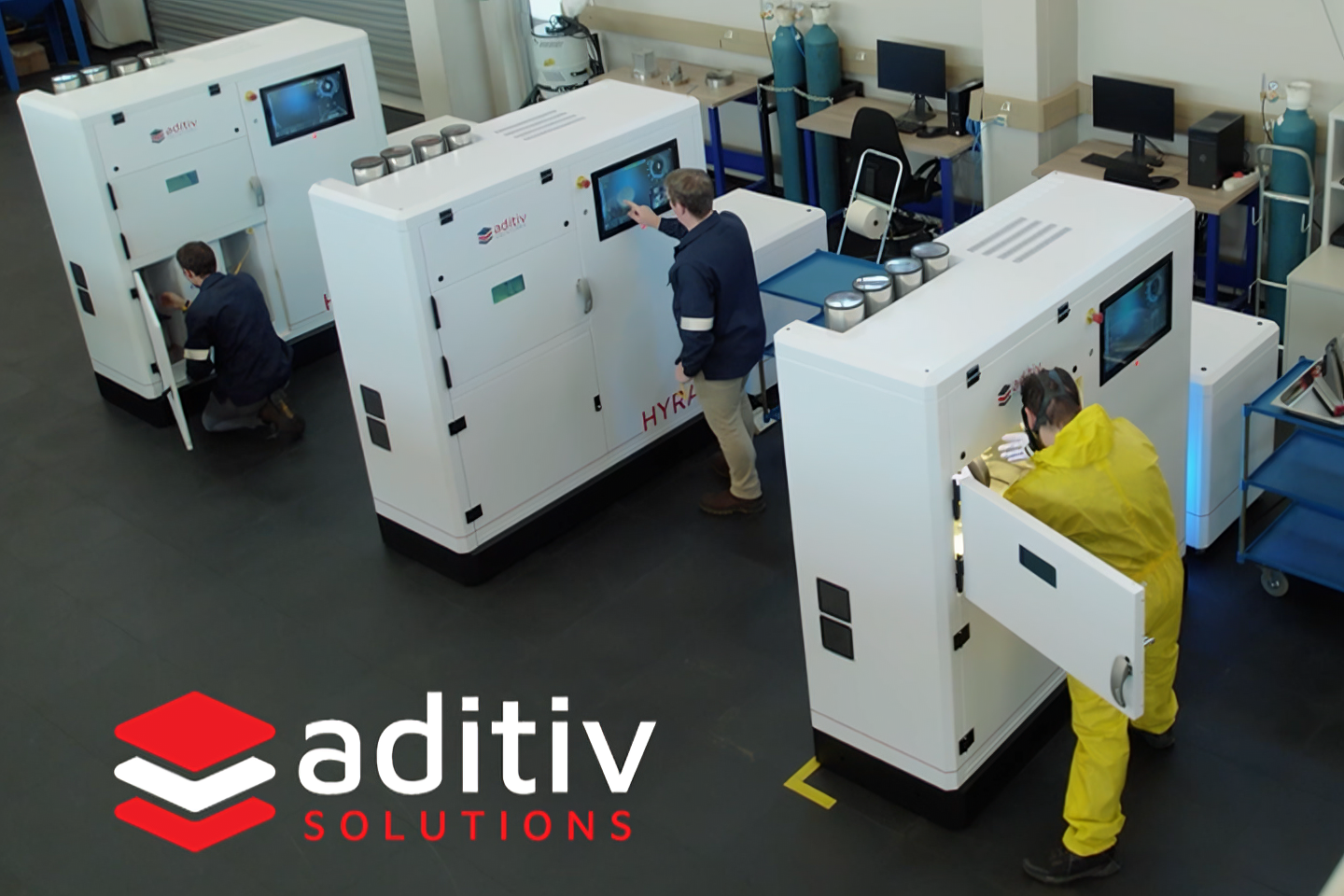
In 2019, Marius founded Aditiv Solutions to develop a range of affordable metal 3D printing systems to be used in various industrial sectors. The company’s flagship system is called the HYRAX which is one of the most cost-efficient metal powder bed fusion system in the world.
Marius is co-author of the “South African Additive Manufacturing Roadmap”. He holds numerous patents in the field of Additive Manufacturing and has served on multiple executive committees, including the Rapid Product Development Association of South Africa (RAPDASA) as well as ASTM’s committee F42 which develops standards for Additive Manufacturing.
Abstract:

Kimon Paxinos
Company: UViRCO
Title: Global Sales and Marketing Executive
Topic: Printing Time and Space
Bio:
Kimon Paxinos is the Global Sales and Marketing Executive at UViRCO Technologies, a company recognised internationally for advanced ultraviolet and infrared imaging systems used in high-voltage inspection and industrial reliability applications. He works closely with utilities, industrial operators, and technology partners across global markets, helping translate advanced engineering into practical operational solutions.
At UViRCO, Kimon has been closely involved in integrating additive manufacturing into product development using printing technologies to manufacture components and covers for the company’s CoroCAM imaging systems. He has a strong interest in how advanced manufacturing is transforming industrial design, production flexibility, production timelines, and product customisation that reflects the preferences of different global markets.
Kimon is known for his energetic communication style, commercial insight, and enthusiasm for emerging technologies and their real-world industrial applications.
Abstract:
Title: Printing Time and Space
Sub Title: Additive Manufacturing as a Strategic Enabler for Advanced Multispectral Imaging Systems
Additive manufacturing is rapidly transforming the way advanced industrial imaging systems are designed, manufactured, customised, and maintained. At UViRCO Technologies, additive manufacturing technologies are increasingly being incorporated into the development of the CoroCAM range of ultraviolet (UV), infrared
(IR), visual, drone-mounted, handheld, and fixed-mounted inspection cameras. These technologies present opportunities not only for rapid prototyping, but also for functional integration, thermal optimisation, supply-chain resilience, product differentiation, and low-volume customised manufacturing.
This presentation explores how additive manufacturing enables UViRCO to rethink both the structural and functional design of its imaging platforms.
1. Product Customisation for Global Markets
UViRCO continuously advances the core performance of its imaging systems through improvements in optics, sensors, onboard processing, and image analytics. Historically, however, the external industrial design of many systems has remained relatively unchanged because conventional injection moulding requires expensive tooling and favours long production runs with standardised designs.
Additive manufacturing fundamentally changes this constraint. It enables regional and customer-specific product customisation without the financial burden of redesigning and manufacturing new moulds. This creates opportunities to tailor external housings, ergonomics, textures, branding, colour schemes, and accessory integration for different global markets and operational environments. In practice, different customer groups evaluate technology differently. Technically focused users prioritise imaging performance and sensor capability, while others place significant value on aesthetics, perceived ruggedness, ergonomics, and industrial design refinement. Additive manufacturing allows both requirements to
coexist through modular and rapidly adaptable product design.
The approach also supports accelerated product iteration cycles and lower inventory requirements, enabling UViRCO to evolve product designs more dynamically in response to market feedback and changing operational requirements. Low-volume production becomes commercially viable without the traditional penalties associated with tooling amortisation.
2. Drone-Based Imaging Systems and Gimbal Development
UViRCO’s UVS drone-mounted imaging platforms represent an ideal application for additive manufacturing. Drone payload systems require lightweight structures, precise geometries, high stiffness-to-weight ratios, and rapid design adaptation as drone technologies evolve.
Additive manufacturing enables the development of customised gimbals and mounting systems optimised for specific drone platforms and operational use cases. Rapid prototyping significantly reduces development cycles and allows iterative refinement of aerodynamic performance, weight distribution, vibration isolation, and structural rigidity. Because drone-mounted inspection systems are typically produced in relatively low
volumes, additive manufacturing offers substantial commercial advantages over conventional machining and tooling approaches. Metal additive manufacturing additionally enables the production of highly complex lightweight structures that would be difficult or uneconomical to manufacture conventionally. Aerospace industries increasingly use similar approaches to reduce component weight while improving structural performance.
The technology also supports mission-specific customisation, including the integration of additional sensors, communication modules ( and their positioning), cooling channels, and protective structures directly into the printed assembly.
3. Fixed-Mounted Systems and Integrated Thermal Management
Fixed-mounted camera systems within UViRCO’s Visual Monitoring Imaging (VMI) range present significant opportunities for functional integration through additive manufacturing.
Thermal management remains one of the most critical engineering challenges in high-performance imaging systems. Conventional cooling solutions often require separate heat exchangers, fans, cooling plates, or external assemblies that increase complexity, weight, and enclosure size.
Additive manufacturing allows cooling channels and heat exchanger geometries to be integrated directly into the enclosure structure itself. Advanced conformal cooling systems and gyroid-based heat exchanger structures can maximise heat dissipation while reducing overall system footprint. These geometries offer exceptionally high surface-area-to-volume ratios and improved thermal efficiency compared with
conventional cooling approaches.
The incorporation of integrated cooling pathways into the camera housing creates a more compact, robust, and thermally efficient system architecture. Heat transfer to the external environment can be optimised while simultaneously reducing component count and improving environmental durability.
Additive manufacturing also enables redesign of internal structural frameworks to accommodate multiple sensor formats and evolving supply-chain realities. Infrared sensors vary significantly in dimensions, availability, performance, and cost. Conventional manufacturing methods make adapting to these variations expensive and slow. By contrast, additively manufactured internal support structures can be rapidly modified to accommodate different sensor packages without requiring complete enclosure redesigns.
This flexibility improves UViRCO’s ability to respond to component shortages, supply-chain disruptions, and emerging sensor technologies while maintaining production continuity.
4. Handheld Camera Systems and Next-Generation Enclosures
Handheld inspection cameras present a particularly compelling case for additive manufacturing. Traditional plastic injection moulding requires expensive tooling investment and large production volumes to remain economically viable. Once moulds are produced, manufacturers become effectively locked into a specific design configuration.
Advanced nylon-based additive manufacturing offers a more agile alternative. Modern engineering nylons used in additive manufacturing provide excellent durability, wear resistance, impact resistance, and thermal stability. UV-stabilised nylon materials additionally improve long-term environmental resistance for outdoor industrial applications.
Additive manufacturing enables more refined industrial finishes while simultaneously reducing tooling costs, warehouse inventory, and storage requirements. Product revisions can be implemented rapidly without scrapping obsolete moulds or carrying excess stock.
The technology also enables advanced ergonomic and ruggedisation features that are difficult to implement using conventional moulding techniques. Anti-slip textures, integrated grip structures, reinforcement lattices, shock absorption zones, and operator-specific ergonomic refinements can be directly incorporated into the enclosure design.
Titanium and metal additive manufacturing additionally create future opportunities for highly ruggedised specialist enclosures where weight reduction, structural rigidity, corrosion resistance, and premium finishing are critical operational requirements.
5. Strategic Benefits of Additive Manufacturing for Industrial Imaging
The integration of additive manufacturing into the CoroCAM product ecosystem extends beyond manufacturing efficiency. It enables a broader shift towards functionally integrated, adaptive, and market- esponsive imaging systems.
Key advantages include:
- Reduced tooling dependency and lower capital expenditure.
- Faster product development and prototyping cycles.
- Low-volume manufacturing capability with economically viable customisation.
- Improved thermal management through integrated cooling geometries.
- Reduced weight and improved structural optimisation.
- Enhanced ergonomic and ruggedisation capabilities.
- Greater supply-chain adaptability and sensor integration flexibility.
- Lower inventory requirements and reduced warehousing costs.
- Increased product differentiation across international markets.
For UViRCO, additive manufacturing is not merely a production technique. It is becoming a strategic engineering capability that supports innovation across design, manufacturing, operational performance, and customer engagement.

Dino Kartoudes
Company: Barrows
Title: Head of Additive Manufacturing
Topic: Integrate, Accelerate, Innovate: How Barrows Leverages AM to Outpace Supply Chain, Integrate With Traditional Manufacturing and Accelerate Innovation.
Bio:
With work showcased internationally at world-leading expos and in collaboration with Companies on the frontier of AM:
Formnext Germany: World’s largest Additive manufacturing expo in 2025, Partnered with CEAD
JEC Paris: the world’s leading composite expo in 2025 & 2026, Partnered with CEAD
Goodwood Festival Of Speed: Showcased in the UK in 2025, Partnered with DASH
With additional collaborations in the UK, the Netherlands, the Czech Republic, Cyprus, Innsbruck and more…
I am part of a passionate team of 3 supporting a company of over 300, driving real-world products into the global markets
MSc: Computational Design & Digital Fabrication, jointly accredited through the University of Nicosia and the University of Innsbruck (Awarded Summa Cum Laude with a GPA of 4.00 – 4.00, completing my Master’s as the top student of my faculty )
BSc. Architecture Through the University of Pretoria
Featured in Let’s Clay 3D Print! A Guidebook by Hendrien Horn
8+ Years of Design & Additive Manufacturing Experience
Abstract:
Integrate, Accelerate, Innovate: How Barrows Leverages Leading-Edge Design & Additive Manufacturing for Real-World Production
Abstract
1. Quick Introduction to Speakers
2. Barrows: A Retail Design, Media & Tech Company
3. Large Format Additive Manufacturing
4. How Additive is Leveraged in Retail Manufacturing
5. Reducing Complexities, Processes, and Supply Chains
6. Crafting Exciting Designs, While Keeping Manufacturing in Mind
7. Surface Textures & Infill Patterns
8. Accelerated Innovation & Iteration
9. Global Design Collaboration

Brett Horn
Company: Barrows
Title: Head Of Product Innovation
Topic: Integrate, Accelerate, Innovate: How Barrows Leverages AM to Outpace Supply Chain, Integrate With Traditional Manufacturing and Accelerate Innovation.
Bio:
With three decades of experience spanning industrial design and engineering, global branding, and cutting-edge production, Brett brings a holistic perspective to the world of Additive Manufacturing. After qualifying as an Industrial Designer from the University of Johannesburg in 1996, Brett cut his teeth on complex military and industrial projects before finding his stride in the brand ecosystem, joining Barrows in 2002.
His career includes a stint in the US, shaping Coca-Cola’s global design footprint, working alongside heavyweights like Pininfarina and BMW Designworks. After a successful five-year tenure heading up Barrows’ creative studio, Brett shifted his focus to business-wide product development—bridging the gap between design, engineering, and the factory floor. His journey with additive manufacturing began in 2016, and over the last decade, he has been embedding 3D printing and advanced manufacturing processes into real-world, scalable client solutions.
Abstract:
Integrate, Accelerate, Innovate: How Barrows Leverages Leading-Edge Design & Additive Manufacturing for Real-World Production
Abstract
1. Quick Introduction to Speakers
2. Barrows: A Retail Design, Media & Tech Company
3. Large Format Additive Manufacturing
4. How Additive is Leveraged in Retail Manufacturing
5. Reducing Complexities, Processes, and Supply Chains
6. Crafting Exciting Designs, While Keeping Manufacturing in Mind
7. Surface Textures & Infill Patterns
8. Accelerated Innovation & Iteration
9. Global Design Collaboration

Philip Van Der Walt
Company: The Additive Manufacturing Institute
Title: Founder & Creative Director
Topic: Strategic Integration of Additive Manufacturing in Diverse Product Development Lifecycles
Bio:
Philip van der Walt is a product artist and designer specializing in Design for Additive Manufacturing (DFAM), with over twenty years of experience in the Additive Manufacturing (AM) industry. Through his company, the Additive Manufacturing Institute (AMI), he collaborates with academic institutions and private enterprises across diverse design sectors, focusing on rapid product development and training in fields such as medical, marine, architecture, and other industrial applications. Additionally, he is the founder of Nexus Advanced Geometries, a design studio dedicated to high-end luxury brands and products, where he partners with artists and designers in fashion, product art, jewellery, and premium retail. Links to his work:
The Additive Manufacturing Institute | www.aminstitute.co.za
Abstract:
Additive manufacturing (AM) has evolved from a prototyping tool into a foundational element of contemporary product development. By assessing when and why AM should be employed, we have strategically integrated AM technologies and Design for Additive Manufacturing (DFAM) into our product development lifecycle across a range of industries. These applications span high-end luxury brands, including jewellery, fashion, footwear, retail products, and art, as well as industrial product development for marine, and architectural sectors. Additionally, AM plays a critical role in developing medical products, such as implants, orthotics, prosthetics, and assistive devices. From accelerating early-stage concept validation to enabling agile iterations and custom solutions, AM enhances design flexibility while optimizing cost and performance. This discussion will offer practical insights, case studies, and lessons learned from real-world applications, illustrating how AM drives innovation across diverse sectors.

Jurgens Taljaard
Company: Aditiv Solutions
Title: Mechanical Engineer, Additive Specialist
Topic: The nuts and bolts of Metal 3D Printing
Bio:
Mechanical Design Engineer and Additive Manufacturing Specialist at Aditiv Solutions, brings seven years of expertise in designing for additive manufacturing, including four years focused on selective laser melting (SLM) and three years with FDM processes. Holding a Master’s degree in Mechanical Engineering with a specialization in post-processing of additive parts, Jurgens has a passion for designing high-performance metal components, particularly for golf applications. His work centers on SLM machine design and optimizing metal additive components to enhance performance through innovative geometries and tailored post-processing techniques. Passionate about bridging the gap between complex SLM processes and practical applications, Jurgens has a knack for making additive manufacturing accessible to newcomers. In this presentation, he shares his insights on navigating the realities of SLM to create high-value parts, drawing from his extensive experience in the field.
Abstract:
This presentation explores the selective laser melting (SLM) additive manufacturing process through the journey of designing and producing a high-performance metal part. Following the lifecycle of a component from concept to finished product, we highlight the realities and complexities of SLM, including its costs, design requirements, and post-processing needs. The narrative showcases why SLM is ideal for complex, high-value parts, emphasizing benefits like customization, optimized geometries, and performance enhancements that outweigh its challenges. Key topics include designing for printability with self-supporting geometries to minimize supports, the SLM printing process, and the critical role of post-processing—such as support removal, surface finishing, and heat treatments—tailored to the part’s purpose. We also address cost competitiveness, demonstrating how SLM’s reduced material waste and tooling costs make it viable for niche applications. By weaving practical insights with a compelling story, this 20-minute presentation illustrates how thoughtful design and process management unlock SLM’s potential, transforming innovative ideas into successful realities.

Howden Farham
Company: Out of the Box Design Solutions
Title: Founder / Owner
Topic: From CAD to Confidence: Designing for Production Without
Surprises
Bio:
Howden Farham is an electronic product designer and manufacturing consultant with
more than 50 years of experience spanning electronics, embedded computing,
avionics, industrial control, communications, defence, and consumer products.
Throughout his career, he has specialised in transforming concepts into production-
ready products, combining practical engineering experience with a strong focus on
design-for-manufacture and design-for-assembly principles. His work has included
rugged airborne computers, aircraft support systems, SATCOM antenna systems,
“black-box” flight data recorders, armament controllers, intelligent smoke detection
products, fuel cell powered UAV system, commercial computing equipment, and
robotic pool-cleaning systems.
He collaborated with a South African PCB manufacturer to upgrade its production
facility and introduce advanced multilayer PCB manufacturing capabilities, including
embedded heat-sink planes and rigid-flex interconnect technology.
An early adopter of additive manufacturing technologies, he was among the first South
African users of stereolithography prototypes and subsequently incorporated 3D
printing into product development programmes for more than two decades.
His work emphasises reducing production risk through structured CAD methodologies,
design reviews, prototyping, assembly planning, and close collaboration across the
entire product-development chain.
In this presentation, he shares practical methods for bridging the gap between CAD
intent and successful production outcomes.
Abstract:
Modern CAD systems allow highly sophisticated products to be developed with
remarkable speed and accuracy. Yet many projects still encounter costly redesigns,
manufacturing difficulties, assembly challenges, quality issues, and serviceability
problems once production begins.
These difficulties often arise because manufacturing, assembly, testing, installation,
maintenance, and real-world operating conditions are considered too late in the
development process. Successful products are rarely the result of design effort
alone; they emerge from effective collaboration between designers, suppliers,
manufacturers, assemblers, inspectors, service personnel, and end users.
This presentation explores practical methods for integrating production thinking into
every stage of product development. Drawing on more than five decades of
experience across commercial, industrial, aerospace, defence, and consumer
markets, the session examines how potential production risks can be identified and
addressed before tooling, procurement, and manufacturing commitments are made.
Using real-world case studies, including additive-manufactured prototypes,
embedded computing systems, avionics equipment, intelligent smoke detection
products, SATCOM systems, and a robotic swimming pool cleaner developed from
concept through production planning, the presentation demonstrates how structured
CAD assemblies, progressive design reviews, prototyping, assembly sequencing,
fixture design, serviceability planning, and manufacturing-aware modelling can
significantly improve product readiness.
Particular emphasis is placed on manufacturability, assembly access, tolerance
awareness, component organisation, design documentation, tooling considerations,
and communication throughout the development chain.
Attendees will gain practical strategies for reducing redesign cycles, improving
manufacturability, strengthening collaboration between disciplines, and transforming
CAD models into production-ready products with greater confidence and fewer
surprises.

Jean Pitot
Company: Aerospace Systems Research Institute (ASRI)
Title: Deputy Director & Chief Engineer
Topic: An Update on ASRI’s current AM activities
Bio:
Prof Jean Pitot is co-founder, deputy director and chief engineer of the University of KwaZulu-Natal’s Aerospace Systems Research Institute (ASRI), in Durban, South Africa and an associate professor at the University’s Discipline of Mechanical Engineering. ASRI’s fundamental mission, and Jean’s driving passion, is to develop a sovereign space launch capability for South Africa and the African continent at large. As ASRI’s chief engineer, he oversees and directs all technical and R&D work conducted by ASRI’s engineering staff. Jean holds a PhD from Stellenbosch University, and bachelor’s and master’s degrees from the University of KwaZulu-Natal; all in mechanical engineering. He is a member of the American Institute of Aeronautics and Astronautics and the Royal Aeronautical Society.
Abstract:
The Aerospace Systems Research Institute (ASRI), based at the University of KwaZulu-Natal, specialises in the development of rockets and rocket propulsion systems and ultimately aims to establish a sovereign space launch capability for South Africa and Africa at large. In the NewSpace era, metal additive manufacturing has had a major impact on how rocket and rocket engine components are fabricated, leading to considerable reductions in part complexity, cost and production time. This talk will shed light on how the technology is being applied in the manufacture of rocket engines globally, and will detail parts ASRI has, is and plans to produce using metal additive manufacturing, as well as the associated challenges ASRI needs to manage in the process.

Nik Ivanovic
Company: Dragonfly Aerospace
Title: Head of Mechanical Engineering
Topic: The Straight Line Tax – How Orthogonal Manufacturing and Design Weighs Down Space Flight
Bio:
Nik has a keen interest in additive manufacturing as it applies to high-tech industries. He holds a BSc Eng (Mech) and an MSc Eng in Additive Manufacturing from Wits University. He has experience in data science and software development, management consulting in the finance sector, and most recently was the General Manager of Akhani 3D. He now leads the mechanical engineering team at Dragonfly Aerospace, advancing the manufacturing capabilities and design doctrines for products in the Space industry. Dragonfly are manufacturers of imaging payloads for satellites, as well as the satellite buses themselves, and they aim to leverage advanced manufacturing technologies such as additive manufacturing for it’s truest and most salient benefits.
Abstract:
In a world (still) dominated by engineering designs driven by traditional manufacturing technologies, we find ourselves paying somewhat invisible but ever-present taxes imposed by such relatively primitive geometries. Every flat panel, every cantilevered bolted connection, every span, and indeed at its core, every straight line, contributes towards structural inefficiencies that stack with complexity of load path, to result in a design which carries with it excessive mass, and insufficient stiffness. In an industry where the natural frequency of hardware systems is paramount – the key to mastery of design, is to maintain absolute awareness of how these shape the dynamics and ultimate efficiency of a structure and in respecting the equation of the natural frequency of a system – the square root of the ratio of stiffness to mass. Mass lowering a system’s natural frequency, and stiffness increasing it. Within this equation however, lies necessary evil. One cannot have stiffness without some material (mass) present to provide it. However, where and how one arranges this mass, is everything. It is therefore critical in the space industry to explore the more advanced avenues of design and manufacturing, that can yield more efficient structures and load paths, all the way from smaller internal components and brackets, to the primary satellite bus structures themselves, to explore where opportunities lie to break free of this ‘straight line tax’ and start to compound the benefits throughout the full load path of more efficient designs.

Denislav Marinov
Company: Amnova
Title: CEO / Founder
Topic: Beyond the Build Volume: Industrial Applications of Large Format Additive Manufacturing.
Bio:
Denislav is the founder and director of Amnova, an advanced manufacturing company specializing in large format additive manufacturing technologies, digital fabrication and custom machine development. He has led the company for the past six years, building both production capabilities and proprietary manufacturing systems from the ground up. With more than 12 years of experience in the additive manufacturing industry, Denislav’s work sits at the intersection of engineering, materials science and industrial innovation.
With a background in Physics, Chemistry and Materials Science, Denislav‘s experience provides a strong technical foundation for his work in advanced manufacturing technologies and material driven product development. Through his work, Denislav continues to explore how additive manufacturing can enable more agile, localised and scalable production systems, particularly within emerging manufacturing ecosystems.
Abstract:
Denislav Marinov Abstract.
agenda
Time
Item
Speaker / Note
8:30
Arrival & coffee
Get tagged and fuel up with
*engineering rocket fuel”.
9:00
Welcome & brief introduction
Philip Van Der Walt
9:10
Additive Manufacturing in South Africa and beyond
Marius Vermeulen
(CEO, Aditiv Solutions)
9:40
Printing Time and Space
Kimon Paxinos
(Global Sales and Marketing Executive UViRCO)
10:05
Integrate, Accelerate, Innovate: How Barrows Leverages AM to Outpace Supply Chain, Integrate With Traditional Manufacturing, and Accelerate Innovation.
Dino Kartoudes (Head of AM) &
Brett Horn (Head Of Product Innovation)
Barrows
10:30
Break: Coffee & conversation
11:00
Strategic integration of additive manufacturing in diverse product development lifecycles
Philip Van Der Walt
(Director, The AM Institute)
11:25
The nuts and bolts of metal 3D printing
Jurgens Taljaard
(Engineer, Aditiv Solutions)
11:50
From CAD to Production Without Surprises
Howden Farham
(Senior Product Design Engineer)
12:15
Lunch: Feast, mingle and check out the exhibits
13:20
An Update on ASRI’s current AM activities
Jean Pitot
(Co-Founder & Chief Engineer, ASRI)
13:45
The Straight Line Tax – How Orthogonal Manufacturing and Design Weighs Down Space Flight
Nik Ivanovic
(Head of Mechanical Engineering, Dragonfly Aerospace)
14:10
Beyond the Build Volume: Industrial Applications of Large Format Additive Manufacturing
Denislav Marinov
(CEO / Founder, Amnova)
14:35
How can you access AM machines or services for your business?
Marius Vermeulen
(CEO, Aditiv Solutions)
15:00
Afternoon Coffee Break
15:30
Q&A panel discussion
16:15
Launchpad: Taking AM Back to Your Workshop
Days until the event:
Day(s)
:
Hour(s)
:
Minute(s)
:
Second(s)
Buy your ticket today!
Just add the event (below) to our online Basket.
Payment options:
- Bank Card (Via the secure Payfast gateway)
- Direct Bank Transder / EFT
Industrial 3D printing in South Africa (One-day Seminar) – Cape Town
R1490,00 Incl. VAT
Buy your limited ticket to this event today!
Ticket sales close on Friday, 17 June 2026.
Making the Leap: How Additive Manufacturing Can Work for You
Unlock the power of metal 3D printing in this one-day seminar! Learn how Additive Manufacturing (AM) is transforming industries and explore real-world case studies. Perfect for manufacturers, engineers, and innovators looking to integrate AM into their workflow. Limited seats available—book now!
Out of stock